Analysis / 04 Six themes

The architecture
of decision

Institutional analysis Not attributed opinion

What follows is an examination of what senior police leadership demands as a discipline. It is written as institutional analysis, not as a personal philosophy attributed to any officer. Statements that describe Wabang Jamir specifically are drawn from the documented record and are marked as such; everything else is a general reading of the role.

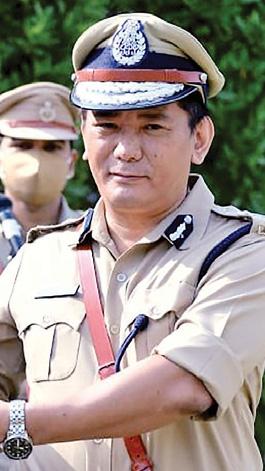
Wabang Jamir, IPS, in peaked cap and service uniform standing at attention during an official ceremony.
Senior command — Gujarat Police

Framing

Command is a
reading problem
before it is an
action problem

By the time a matter reaches a senior police officer, the easy version of it has already been resolved somewhere below. What arrives at the top of a police organisation is what is contested, incomplete, urgent or all three at once.

The six themes on this page are the ones that recur across policing literature, national police commission reporting and the practical structure of Indian police administration. They are set out here because they describe the terrain any officer at Additional Director General rank is operating in — including in a commissionerate the size of Surat.

Theme 01

Clarity

A police organisation of any size generates more demand than it can meet. Every day produces more calls, more registered matters, more requests for presence and more competing claims on the same finite establishment than can possibly be answered in full. Leadership at the senior level is therefore, first of all, an exercise in ordering.

Clarity in this sense is not simplification. It is the willingness to state plainly what is being prioritised, what is being consciously deferred, and on what basis that choice was made — so that the officers carrying it out are not left to infer intent, and so that the decision can be examined afterwards.

The alternative is the more common failure: an organisation in which everything is nominally a priority, which in practice means the allocation of effort is decided by whoever shouted most recently.

Institutional analysis
Theme 02

Intelligence

Information is not intelligence. Information becomes intelligence only after it has been collected against a defined requirement, checked for reliability, set against what is already known, and assessed by someone prepared to say how confident they are and why.

The discipline that matters most here is the least dramatic one: the honest representation of uncertainty. An assessment that conceals how thin its basis is will eventually produce a decision that the evidence never supported. A senior officer’s real protection is a culture in which subordinates are able to report that they do not yet know.

On the record: Wabang Jamir served as Inspector General of Police (Intelligence – 1) at the Gujarat State CID (IB) in Gandhinagar, and it was in that post that he was awarded the Police Medal for Meritorious Service in 2021. His qualifying degree is in Electronics and Communication Engineering. No operational detail of that service is published here.

Documented · see Career
Theme 03

Coordination

Almost nothing a modern police force is asked to deliver can be delivered by the police alone. Traffic management depends on municipal engineering. Public event safety depends on district administration, fire services and transport authorities. Economic offences depend on regulators and banks. Prosecution outcomes depend on forensic capacity and the courts.

Coordination is therefore not a soft skill appended to command; it is a substantial part of the work itself. Much of a senior officer’s week is spent in the space between institutions, where no one has authority over everyone and outcomes depend on whether the relationships were built before they were needed.

Institutional analysis
Theme 04

Accountability

The police are among the few institutions permitted to restrict the liberty of a citizen. That permission is conditional, and the conditions are the point: supervision, documented decision-making, judicial oversight, departmental inquiry and answerability to the government of the day.

Senior officers are the level at which these conditions are either enforced or quietly eroded. The signal a command sends about what it will not tolerate is read far more accurately by an organisation than any circular, and it is read chiefly from what happens after something has gone wrong.

Accountability understood well is not a constraint on operational effectiveness. It is what makes effectiveness durable, because it is what keeps the institution’s authority intact between one incident and the next.

Institutional analysis
Theme 05

Adaptability

The problems arriving at an Indian police station in 2026 are not the ones the organisational structure was designed around. Financial fraud is committed remotely and at scale. Evidence is substantially digital. Rumour propagates faster than any official clarification. Cities absorb populations faster than their institutions expand.

Adapting to this is only partly a technology question. It is more often a question of training, of establishment structure, of which capabilities are built in-house, and of whether an organisation can retire a practice that has stopped working. Technology adopted without the organisational change around it tends to produce new records rather than new outcomes.

Relevant to the record: Wabang Jamir entered the service with an engineering qualification in Electronics and Communication and has served extensively in an intelligence function. Both facts are documented; the inference that they bear on technological adaptability is this site’s interpretation, not his stated position.

Interpretation · clearly marked
Theme 06

Public Trust

Policing in a democracy operates on consent it cannot compel. A force that is trusted is told things earlier, is resisted less often, needs to use force less frequently, and recovers faster when it makes a mistake. A force that is not trusted must substitute effort for legitimacy, and the substitution is always more expensive.

Trust is built in the ordinary transactions rather than the exceptional ones: how a complaint is received at the counter, whether a caller is told the truth about what will happen next, whether a citizen who is inconvenienced is treated as a citizen.

This is why the positioning statement on this site’s homepage places clarity, responsibility and public trust together. They are not three separate virtues. They are one operating condition, described from three angles.

Institutional analysis

A necessary note

On attribution

No quotation, speech, interview or declared philosophy is attributed to Wabang Jamir anywhere on this page or this website. The themes above are the site’s own analysis of the discipline of senior police leadership.

Where a paragraph states something about him specifically, it is drawn from the documented record and is marked On the record or Relevant to the record. Where a connection is drawn between documented facts, it is marked as interpretation. This distinction is maintained deliberately throughout the site.

From information to decision